WEEK 1: SHARE
Friday, November 5th
"Friends & Family Friday" -Research shows that diabetes has a genetic component: Who in your family or circle of friends has diabetes?
I'm fixing to leave to go away for the weekend with my husband, so today's post will be short!
I have many people in my immediate and extended family with Diabetes. I have a great aunt, a great uncle, and a second cousin who have Type 2; a great uncle who passed away as the result of complications from Type 2; as well as more extended family that I can't think of at the time being who are also affected by the disease.
In my immediate family, my sister was diagnosed with Type 1 at age 16. She's now almost 20 and going to college to become a phlebotomist. She was in Diabetic Ketoacidosis by the time she was diagnosed, and was flown out by helicopter to the nearest major hospital (two hours away), where she spent some time recovering. She gave herself insulin shots for the first couple of months, but eventually got on the insulin pump, which she says makes her life a lot easier.
My dad was diagnosed around one and a half to two years ago at around the age of 46 with Type 2. At first the local doctors wanted to put him on Metformin (brand names Fortamet, Glucophage, Glumetza)to treat his Diabetes, but the endocrinologist he saw (who is also my, and my sister, and my mom's doctor!) simply put him on a strict diet. He lost around 30 pounds in the first couple of months as a result of that and exercise, and now he is able to control his Diabetes much easier. It's my hope that I'll be able to do the same, but I suppose time will tell.
I read an article in the latest "Diabetes Forecast" magazine on a study that found that thin people with Diabetes were more likely than overweight people with the disease to have a family member who also has it...In other words, genetics and lifestyle could likely be separate risk factors for the disease. I found this interesting, especially since I'm not overweight, 22, and have Type 2--I certainly don't fit the typical mold for my diagnosis.
Well, I have to go pack, but I hope everyone has a wonderful weekend, and I'll be posting tomorrow!
Friday, November 5, 2010

Thursday, November 4, 2010
Diabetes Celebrities
WEEK 1: SHARE
Thursday, November 4th
Diabetes Celebrities-From rock stars like Bret Michaels to professional athletes like Jay Cutler, people with diabetes are showing how diabtes hasnot stopped them. Who's your favorite diabetes celebrity?
There are plenty of celebrities that deal with Diabetes, many of whom people are surprised to find out have the disease. Shortly after I was diagnosed, I became curious about that very subject. dLife has a great section on famous people with Diabetes, and provides a short article on that person and how the disease fits into their life.
You can read more about them on the dLife website:
http://www.dlife.com/diabetes/information//inspiration_expert_advice/famous_people/
I'm glad Bret Michaels (Type 1) has been such a vocal proponent of the StopDiabetes movement. I think it helps raise awareness when such a well-known celebrity shares that part of his life with the public...After all, if it can happen to someone famous, it can happen to a "normal" person as well, and people become interested.
I was surprised to find that Halle Berry has Type 1 Diabetes. I don't know why that is, but I'm sure it has to do with the fact that we generally tend to elevate celebrities in our mind as people who are beyond "common" illnesses...Which, obviously, is definitely not the case. Michael J. Fox struggles with Parkinson's Disease; Patrick Swayze and Lance Armstrong, cancer. Their illnesses have all been widely discussed in the media., so why is it that we never hear of celebrities who are affected by diabetes, other than Nick Jonas? (I admire him for being so open and proactive, especially since he gives younger children and teens with diabetes a role model to look up to). Is it because it's such a "commonplace", and generally chronic (rather than acute) disease? I personally think it also has to do with the fact that the seriousness of diabetes is often downplayed, i.e. "He just has to watch his sugar;" or "Oh, she just has to take medicine/insulin, but it's not that big of a deal;" etc. I honestly believe there is an overall lack of understanding of the implications Diabetes has on the lives it affects, and I hope that the StopDiabetes movement and American Diabetes Month will increase awareness on the subject.


Anyway, I chose Halle Berry as my "favorite Diabetes celebrity" because although Ms. Berry's Diabetes and her comments on it have been a subject of debate in the medical world, she's a confident, beautiful woman. She has played in many big movies, including some with pretty intensive action roles. But, more importantly to me, she is also a mom. On March 16, 2008, almost 20 years after she was diagnosed with Diabetes, she gave birth to Nahla Ariela Aubry. One of my main concerns in being diagnosed was whether or not I would be able to have a successful, healthy pregnancy in the future. My endocrinologist assured me that I would be "fine" when the time comes, but it's still a major focus of mine because it motivates me to be as healthy as I can be before we decide to have kids. That I found out about my Diabetes before becoming pregnant is one of the things I've been most thankful for over the last couple of months, because now I'll be prepared to do what I can to lower my risk of complications and birth defects (which, by the way, is about the same as a woman without Diabetes if your numbers are within normal range before conception).
I've recently been reading up on the subject of Diabetes and Pregnancy, and a couple of books have been instrumental in increasing my knowledge and understanding of it. The ADA's "101 Tips for a Healthy Pregnancy with Diabetes" by Patti Bazel Geil and Cheryl Alkon's "Balancing Pregnancy with Pre-Existing Diabetes: Healthy Mom, Healthy Baby" are the only books I've found pertaining directly to Diabetes in Pregnancy, as most pregnancy books only provide a small section on Diabetes (usually Gestational), and most Diabetes books only have a small section on pregnancy. I was especially happy to find Cheryl Alkon's book, because it was published in 2010 and is, therefore, up to date on the lates medical knowledge, and is detailed in its scope of information. The ADA's book on the subject is a bit more outdated, but still a good resource in question-and-answer format. I had to buy a used copy on Amazon because a new one wasn't available, so I'm guessing it's probably out of print.
I've been taking prenatal vitamins and folic acid supplements the last few months because their importance is stressed in every book on pregnancy that there is. In his book "Get Ready to Get Pregnant", Michael C. Lu suggests taking them beginning as far in advance as a year before you plan to conceive, and any book will tell you it's a good idea if there's even a possibility that you could become pregnant, because they help to prevent birth defects in those crutial first few weeks of pregnancy (a time when most women aren't even aware they're pregnant, and when the heart, spinal cord, and nervous system are being formed). This is especially important in women with pre-existing Diabetes. My thought is that it definitely can't hurt anything, and at least if we happened to conceive without planning to, our baby would have the best possible chances of normal development.
Thursday, November 4th
Diabetes Celebrities-From rock stars like Bret Michaels to professional athletes like Jay Cutler, people with diabetes are showing how diabtes hasnot stopped them. Who's your favorite diabetes celebrity?
There are plenty of celebrities that deal with Diabetes, many of whom people are surprised to find out have the disease. Shortly after I was diagnosed, I became curious about that very subject. dLife has a great section on famous people with Diabetes, and provides a short article on that person and how the disease fits into their life.
You can read more about them on the dLife website:
http://www.dlife.com/diabetes/information//inspiration_expert_advice/famous_people/
I'm glad Bret Michaels (Type 1) has been such a vocal proponent of the StopDiabetes movement. I think it helps raise awareness when such a well-known celebrity shares that part of his life with the public...After all, if it can happen to someone famous, it can happen to a "normal" person as well, and people become interested.
I was surprised to find that Halle Berry has Type 1 Diabetes. I don't know why that is, but I'm sure it has to do with the fact that we generally tend to elevate celebrities in our mind as people who are beyond "common" illnesses...Which, obviously, is definitely not the case. Michael J. Fox struggles with Parkinson's Disease; Patrick Swayze and Lance Armstrong, cancer. Their illnesses have all been widely discussed in the media., so why is it that we never hear of celebrities who are affected by diabetes, other than Nick Jonas? (I admire him for being so open and proactive, especially since he gives younger children and teens with diabetes a role model to look up to). Is it because it's such a "commonplace", and generally chronic (rather than acute) disease? I personally think it also has to do with the fact that the seriousness of diabetes is often downplayed, i.e. "He just has to watch his sugar;" or "Oh, she just has to take medicine/insulin, but it's not that big of a deal;" etc. I honestly believe there is an overall lack of understanding of the implications Diabetes has on the lives it affects, and I hope that the StopDiabetes movement and American Diabetes Month will increase awareness on the subject.

1870s Long French Jet Drop Earrings, New 14K Wires : Erie Basin...
$485 - eriebasin.com
Drop earrings »
$485 - eriebasin.com
Drop earrings »
Anyway, I chose Halle Berry as my "favorite Diabetes celebrity" because although Ms. Berry's Diabetes and her comments on it have been a subject of debate in the medical world, she's a confident, beautiful woman. She has played in many big movies, including some with pretty intensive action roles. But, more importantly to me, she is also a mom. On March 16, 2008, almost 20 years after she was diagnosed with Diabetes, she gave birth to Nahla Ariela Aubry. One of my main concerns in being diagnosed was whether or not I would be able to have a successful, healthy pregnancy in the future. My endocrinologist assured me that I would be "fine" when the time comes, but it's still a major focus of mine because it motivates me to be as healthy as I can be before we decide to have kids. That I found out about my Diabetes before becoming pregnant is one of the things I've been most thankful for over the last couple of months, because now I'll be prepared to do what I can to lower my risk of complications and birth defects (which, by the way, is about the same as a woman without Diabetes if your numbers are within normal range before conception).
I've recently been reading up on the subject of Diabetes and Pregnancy, and a couple of books have been instrumental in increasing my knowledge and understanding of it. The ADA's "101 Tips for a Healthy Pregnancy with Diabetes" by Patti Bazel Geil and Cheryl Alkon's "Balancing Pregnancy with Pre-Existing Diabetes: Healthy Mom, Healthy Baby" are the only books I've found pertaining directly to Diabetes in Pregnancy, as most pregnancy books only provide a small section on Diabetes (usually Gestational), and most Diabetes books only have a small section on pregnancy. I was especially happy to find Cheryl Alkon's book, because it was published in 2010 and is, therefore, up to date on the lates medical knowledge, and is detailed in its scope of information. The ADA's book on the subject is a bit more outdated, but still a good resource in question-and-answer format. I had to buy a used copy on Amazon because a new one wasn't available, so I'm guessing it's probably out of print.
I've been taking prenatal vitamins and folic acid supplements the last few months because their importance is stressed in every book on pregnancy that there is. In his book "Get Ready to Get Pregnant", Michael C. Lu suggests taking them beginning as far in advance as a year before you plan to conceive, and any book will tell you it's a good idea if there's even a possibility that you could become pregnant, because they help to prevent birth defects in those crutial first few weeks of pregnancy (a time when most women aren't even aware they're pregnant, and when the heart, spinal cord, and nervous system are being formed). This is especially important in women with pre-existing Diabetes. My thought is that it definitely can't hurt anything, and at least if we happened to conceive without planning to, our baby would have the best possible chances of normal development.
Wednesday, November 3, 2010
"Wordless Wednesday"-The Three Most Important Things That Help with Diabetes Management
WEEK 1: SHARE
Wednesday, November 3rd
"Wordless Wednesday"-Share a picture or video on your blog!
The Three Most Important Things That Help with My Diabetes Management:
1) My Bayer Contour USB Meter
*Please note that I am not in any way affiliated with Bayer--I am just a person with Diabetes, and this is my opinion about my meters.
2) Books on Diabetes
The week I was diagnosed, I had three books on Diabetes shipped to me via two-day delivery so I could read as much as possible about my disease. You see, I'm the kind of person who likes to know everything about everything, especially when it comes to my health. Different people deal differently with the challenges of life, and my method is learning. One of the main reasons I've been able to deal with my diagnosis so well is that after finding out more about the disease, I feel better prepared to deal with it. For me, knowledge truly is power when it comes to Diabetes. Of course, denial and an "ignorance is bliss" attitude are tempting to give in to, but that sort of thinking is only maladaptive and will inevitably lead to a poorer outcome. As Julian Seifter says in his book, "After the Diagnosis: Transcending Chronic Illness," you have to find a balance between "preoccupation and denial". If it isn't already obvious, I tend more toward the preoccupation side; however, the way we deal with things like chronic illness is very indicative of our individual temperaments and personalities--everyone falls in a different place on the continuum.
Nevertheless, here are all of the books that are currently in my collection (either in physical form or on my Barnes & Noble nook) that deal with Diabetes. I haven't finished all of them, but since I'm usually reading several books at a time, I have read parts of each one.
The most helpful book in the beginning was one of the first I read: "The First Year: Type 2 Diabetes: An Essential Guide for the Newly Diagnosed" by Gretchen Becker. It's written with the intention of getting you through each week of the first month, then each month of your first year with Type 2 Diabetes. Each chapter is divided into two sections: Living and Learning. The Living sections focus on dealing with the disease on a day-to-day basis and in the long term, while the Learning sections go over the science of Diabetes. It really has been a valuable resource, and a great introduction to the subject.
The American Diabetes Association's "Complete Guide to Diabetes" is more like the Bible of the Diabetes world. It covers every topic from A to Z on both Type 1 and Type 2 Diabetes, as well as Gestational Diabetes. I've referred back to this one many times, because it provides detailed information on a variety of subjects.
Seifter's "After the Diagnosis" has been a very interesting read because he is both a doctor and a patient living (and at times, struggling) with Diabetes. His prospective is refreshing and he offers some wonderful advice, not only on how to deal with but also on how to live well with a chronic illness. His book really emphasizes looking at the positive side and learning from your illness, as well as growing as a person and finding (and keeping) yourself in the process.
If you want to know more about any of these books, click the links below to visit Amazon or Barnes and Noble, where you can find reviews and purchase them. Since I love to read, I'll try to review these books on my blog in detail after the "30 Days of Diabetes in November" are up.


Wednesday, November 3rd
"Wordless Wednesday"-Share a picture or video on your blog!
The Three Most Important Things That Help with My Diabetes Management:
1) My Bayer Contour USB Meter
 |
| Courtesy of SimpleWins.com |
I was given a Bayer Contour Meter the day I was diagnosed at our local clinic. About a month later, when I met with my CDE (Certified Diabetes Educator), she gave me the Bayer Countour USB Meter. It has made my Diabetes Management fit in better with my daily routine, because I'm on my computer the majority of the day anyway...And, as my CDE said, "Why not get something cool out of the deal? No one asks for this disease, and it's not fun."
I personally like the Contour meters better than my dad's OneTouch, simply because it uses a smaller blood sample--Which really does make a difference, especially on those days when it's difficult to get enough to test. Sometimes I have to stick myself five times before I get enough blood to get a reading--not fun! Anyway, with the USB model, you just plug it into your computer's USB port and install the software (which is one the meter's USB storage device), and you're ready to go.
The thing I like about the Glucofacts software is that it allows me to see, in chart form, what my blood glucose is doing throughout the day or week. It highlights your highs and lows, and gives you the facts about the percentage of your readings that are in your target range, among other things. This is important because you obviously want the majority of your readings to fall within your target (in my case, 70-140) to ensure the best possible control of your Diabetes.
No matter which meter you choose, without a doubt the most important thing is to USE it! If you aren't aware of what your blood glucose is doing throughout the day, you don't have the opportunity to correct it. I would argue that frequent testing (in the morning, before meals, one-two hours after meals) is the single most important thing you can do to manage your Diabetes. When you keep track of your readings and adjust your lifestyle accordingly, you automatically have better control of a disease that always seems to want to control you.
2) Books on Diabetes
The week I was diagnosed, I had three books on Diabetes shipped to me via two-day delivery so I could read as much as possible about my disease. You see, I'm the kind of person who likes to know everything about everything, especially when it comes to my health. Different people deal differently with the challenges of life, and my method is learning. One of the main reasons I've been able to deal with my diagnosis so well is that after finding out more about the disease, I feel better prepared to deal with it. For me, knowledge truly is power when it comes to Diabetes. Of course, denial and an "ignorance is bliss" attitude are tempting to give in to, but that sort of thinking is only maladaptive and will inevitably lead to a poorer outcome. As Julian Seifter says in his book, "After the Diagnosis: Transcending Chronic Illness," you have to find a balance between "preoccupation and denial". If it isn't already obvious, I tend more toward the preoccupation side; however, the way we deal with things like chronic illness is very indicative of our individual temperaments and personalities--everyone falls in a different place on the continuum.
Nevertheless, here are all of the books that are currently in my collection (either in physical form or on my Barnes & Noble nook) that deal with Diabetes. I haven't finished all of them, but since I'm usually reading several books at a time, I have read parts of each one.
The most helpful book in the beginning was one of the first I read: "The First Year: Type 2 Diabetes: An Essential Guide for the Newly Diagnosed" by Gretchen Becker. It's written with the intention of getting you through each week of the first month, then each month of your first year with Type 2 Diabetes. Each chapter is divided into two sections: Living and Learning. The Living sections focus on dealing with the disease on a day-to-day basis and in the long term, while the Learning sections go over the science of Diabetes. It really has been a valuable resource, and a great introduction to the subject.
The American Diabetes Association's "Complete Guide to Diabetes" is more like the Bible of the Diabetes world. It covers every topic from A to Z on both Type 1 and Type 2 Diabetes, as well as Gestational Diabetes. I've referred back to this one many times, because it provides detailed information on a variety of subjects.
Seifter's "After the Diagnosis" has been a very interesting read because he is both a doctor and a patient living (and at times, struggling) with Diabetes. His prospective is refreshing and he offers some wonderful advice, not only on how to deal with but also on how to live well with a chronic illness. His book really emphasizes looking at the positive side and learning from your illness, as well as growing as a person and finding (and keeping) yourself in the process.
If you want to know more about any of these books, click the links below to visit Amazon or Barnes and Noble, where you can find reviews and purchase them. Since I love to read, I'll try to review these books on my blog in detail after the "30 Days of Diabetes in November" are up.

$5.88 - amazon.com
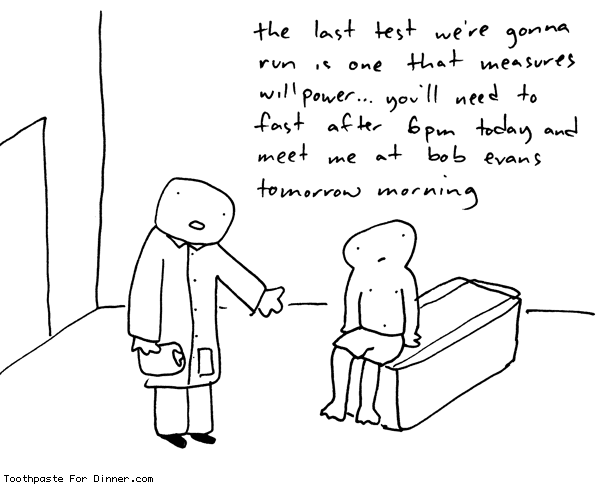
3) Willpower
May refer to:
- Willpower, the strength to act, or forbear from acting, in the pursuit of a goal.
- Self discipline, Training and control of oneself and one's conduct, usually for personal improvement.
- Self control, the ability of a person to exert his/her will over the inhibitions of their body or self.
Willpower. (2010, September 29). In Wikipedia, The Free Encyclopedia. Retrieved 19:13, November 3, 2010, from http://en.wikipedia.org/w/index.php?title=Willpower&oldid=387752392
By far the hardest part of living with Diabetes is dealing with the day-to-day (and even minute-to-minute) decisions that inevitably affect your blood glucose one way or the other..."Should I eat this? No. Am I going to eat this? Probably...But just a little bit." or "I need to go run/ride my bike/walk to bring my blood sugar down/prevent it from going up...But all I really want to do is lay on the couch and relax!" Those types of decisions tend to define your day when you have Diabetes. If you can outlast the temptations to overeat or not exercise, you feel a certain sense of accomplishment. On the flip side, if you end up overeating (even though you didn't plan to), or not exercising (because who really finds that fun an hour after you started eating), you feel like you've failed. And when you've tried your best and think you've done all you can to keep your numbers down and they end up being high anyway, you just feel plain deflated and discouraged.
The challenge, then, it sometimes not so much focused on what you're doing as it is on how you react to the inevitable ups and downs of Diabetes. There will be highs, and there will be lows...It's part of the definition of the disease. If you can somehow manage to do the best you can and learn to live with the occasional (or possibly more frequent) disappointing results, you're doing well in my opinion. It's all part of that balance between preoccupation and denial again.
On a lighter note, I thought you might enjoy some cartoons about willpower, because it's definitely not just people with Diabetes that find this aspect of life challenging!
Tuesday, November 2, 2010
Election Day
WEEK 1: SHARE
Tuesday, November 2nd
Election Day-What issues are important to you? If you could tell your representatives one thing about diabetes, what would it be?
First of all, I'm writing this on a blood sugar low. I'm shaky, hungry (the reason I'm low in the first place), but at least I caught it before I got to the heart racing, hot all over, confused-feeling point...I think. I'll give my fast-acting glucose tablets a few minutes to work, then eat the apples and peanut butter that I was going to eat 30 minutes earlier (but instead got preoccupied with exploring my new laptop.) Incidentally, I left my blood glucose meter at home today on accident, so I'm just having to go by how I feel. I think this is the first time I've forgotten to put it in my purse before leaving for work since my diagnosis!
This is just another example of what it's like to live with a disease that doesn't let you forget about it. You can't exactly "go with the flow" or be spontaneous, especially when it comes to what and when you eat. I bug my husband incessantly when we're going out to eat about where we're going so I can look in my purse-sized calorie/fat/carb guide and decide what to order ahead of time. Sometimes, though, I still end up standing at the counter (i.e., Taco Bell, on Sunday), book in hand, trying to decide what I can fit into my carb limitations. It doesn't embarrass me, but it does add an extra dimension of time-consuming complication to what are supposed to be fun times.
Now on to the theme of today's blog: Election Day
There are a lot of issues that are important to me for this election...I consider myself mostly conservative: pro-life, -traditional marriage, -capitalism, -personal responsibility, -limiting federal powers, etc. HOWEVER that is not what is important to the central idea of this blog. Healthcare is a huge, debate-provoking issue right now, and for good reason...It's our lives that are at stake.
As a person with Diabetes, this issue hits somewhat closer to home for me. As I mentioned in my previous post, one of my greatest long-term fears is the loss of insurance coverage--I had always planned on being a stay-at-home mom in the future once we have kids, but now I'm not sure if that will be possible. Right now, one of the benefits of my full-time job as a CAD Drawing Technician is health insurance. If it weren't for that, I would have already spent over $350 in Diabetes testing supplies alone in the last two months. Test strips cost over $1 apiece, which adds up quickly...Especially if you're testing as often as you should. At a minimum, that's $365 in test strips over a year, if you're testing once a day. For more intensive Diabetes management, I test an average of four-five times per day, sometimes more. That adds up to $1,825 in a year at five tests daily...and again, that's just the cost of the test strips. There are also lancets, alcohol swabs, glucose tablets, doctors' visits, lab tests, extra dental and eye exams, more nutritions (and expensive) food...The list goes on. These are the things a relatively healthy person managing their Type 2 Diabetes without medications will have to deal with. For a person with Type 1, you can add to that list insulin, syringes, a possible insulin pump (which is a several-thousand dollar piece of equipment) along with all of the supplies it entails, and more. And if you have complications from the disease (kidney, heart, neuropathy, vision problems, etc.), there is another whole list of doctors' visits, medications, and even potential surgeries to expect.
The bottom line? Having Diabetes is expensive, if you're taking care of yourself like you should. Of course, if you just ignore the disease (not testing, going to the doctor, dieting, etc.) it's a lot cheaper, but you probably won't live very long! In a way, I feel as if I'm being punished for paying attention to my health and doing everything I can to make sure I don't develop complications from my Diabetes. It definitely isn't fair, but it's the way our system of managed care works. And I have insurance. A $40 specialist co-pay is bad enough, but I can't imagine how much the costs would add up without insurance. It is truly scary (and sad) to think about having to weigh your health against what you can afford.
Therefore, the one thing I would tell my representatives about Diabetes is that the current system works to penalize those who take care of themselves with preventative measures, and that has to change. It's hard enough to find the motivation to take care of yourself with this disease on a day-to-day basis without having to worry about finding the money to do it. I'm no political expert and I don't know what the solution to this problem should be, but I do know that people with Diabetes should be able to effectively, efficiently, and affordably manage their disease without having to fight against a system that is designed to exclude and neglect them. Insurance also has to be available and affordable to those with Diabetes--it's simply inhumane to deny coverage on the basis of preexisting conditions (after all, what else is health insurance for?) or to make it unattainable by radically inflating premiums and deductibles specificially because of them.
There's my soapbox for today! What's yours?
Tuesday, November 2nd
Election Day-What issues are important to you? If you could tell your representatives one thing about diabetes, what would it be?
First of all, I'm writing this on a blood sugar low. I'm shaky, hungry (the reason I'm low in the first place), but at least I caught it before I got to the heart racing, hot all over, confused-feeling point...I think. I'll give my fast-acting glucose tablets a few minutes to work, then eat the apples and peanut butter that I was going to eat 30 minutes earlier (but instead got preoccupied with exploring my new laptop.) Incidentally, I left my blood glucose meter at home today on accident, so I'm just having to go by how I feel. I think this is the first time I've forgotten to put it in my purse before leaving for work since my diagnosis!
This is just another example of what it's like to live with a disease that doesn't let you forget about it. You can't exactly "go with the flow" or be spontaneous, especially when it comes to what and when you eat. I bug my husband incessantly when we're going out to eat about where we're going so I can look in my purse-sized calorie/fat/carb guide and decide what to order ahead of time. Sometimes, though, I still end up standing at the counter (i.e., Taco Bell, on Sunday), book in hand, trying to decide what I can fit into my carb limitations. It doesn't embarrass me, but it does add an extra dimension of time-consuming complication to what are supposed to be fun times.
Now on to the theme of today's blog: Election Day
There are a lot of issues that are important to me for this election...I consider myself mostly conservative: pro-life, -traditional marriage, -capitalism, -personal responsibility, -limiting federal powers, etc. HOWEVER that is not what is important to the central idea of this blog. Healthcare is a huge, debate-provoking issue right now, and for good reason...It's our lives that are at stake.
As a person with Diabetes, this issue hits somewhat closer to home for me. As I mentioned in my previous post, one of my greatest long-term fears is the loss of insurance coverage--I had always planned on being a stay-at-home mom in the future once we have kids, but now I'm not sure if that will be possible. Right now, one of the benefits of my full-time job as a CAD Drawing Technician is health insurance. If it weren't for that, I would have already spent over $350 in Diabetes testing supplies alone in the last two months. Test strips cost over $1 apiece, which adds up quickly...Especially if you're testing as often as you should. At a minimum, that's $365 in test strips over a year, if you're testing once a day. For more intensive Diabetes management, I test an average of four-five times per day, sometimes more. That adds up to $1,825 in a year at five tests daily...and again, that's just the cost of the test strips. There are also lancets, alcohol swabs, glucose tablets, doctors' visits, lab tests, extra dental and eye exams, more nutritions (and expensive) food...The list goes on. These are the things a relatively healthy person managing their Type 2 Diabetes without medications will have to deal with. For a person with Type 1, you can add to that list insulin, syringes, a possible insulin pump (which is a several-thousand dollar piece of equipment) along with all of the supplies it entails, and more. And if you have complications from the disease (kidney, heart, neuropathy, vision problems, etc.), there is another whole list of doctors' visits, medications, and even potential surgeries to expect.
The bottom line? Having Diabetes is expensive, if you're taking care of yourself like you should. Of course, if you just ignore the disease (not testing, going to the doctor, dieting, etc.) it's a lot cheaper, but you probably won't live very long! In a way, I feel as if I'm being punished for paying attention to my health and doing everything I can to make sure I don't develop complications from my Diabetes. It definitely isn't fair, but it's the way our system of managed care works. And I have insurance. A $40 specialist co-pay is bad enough, but I can't imagine how much the costs would add up without insurance. It is truly scary (and sad) to think about having to weigh your health against what you can afford.
Therefore, the one thing I would tell my representatives about Diabetes is that the current system works to penalize those who take care of themselves with preventative measures, and that has to change. It's hard enough to find the motivation to take care of yourself with this disease on a day-to-day basis without having to worry about finding the money to do it. I'm no political expert and I don't know what the solution to this problem should be, but I do know that people with Diabetes should be able to effectively, efficiently, and affordably manage their disease without having to fight against a system that is designed to exclude and neglect them. Insurance also has to be available and affordable to those with Diabetes--it's simply inhumane to deny coverage on the basis of preexisting conditions (after all, what else is health insurance for?) or to make it unattainable by radically inflating premiums and deductibles specificially because of them.
There's my soapbox for today! What's yours?
Monday, November 1, 2010
Introduction
WEEK 1: SHARE
Monday, November 1st
Introduction-Tell us about yourself! Why did you decide to start a blog or share your blog with us?
Hi! I'm Ashley. I'm 22 years old, a newlywed since January, and a 2009 graduate of Texas Tech University. August 23, 2010, I was also diagnosed with Type 2 Diabetes.
The weekend before, I had a feeling I knew what was going on, so I borrowed my dad's blood glucose meter (he has Type 2 as well). My numbers were fairly high, so I made an appointment for Monday afternoon, which confirmed my suspicions. Even though I was somewhat prepared for it, my diagnosis still came as a shock. First of all, I'm in that in-between area age-wise. I'm not quite young enough to be a textbook Type I, but I'm also not old enough to fit the mold of a "typical" Type II. Secondly, I'm not overweight, though I do always tend toward the heavier side of my healthy weight range (according to the BMI scale). I was overweight as a child and adolescent, until about 10 years ago when I finally made the decision to lose weight. Even though my dad and sister (Type I) have the disease (so obviously the genetic component is there), I never dreamed I would have to deal with it.
Nevertheless, my life has changed pretty dramatically in the last two months. Since losing weight in the past, I've always been a fairly healthy eater, but I love carbs. That's probably been the biggest challenge for me thus far, because my endocrinologist had me see a CDE (Certified Diabetes Educator) who recommended that I limit myself to three carbs per meal, and one/two for snacks. Also, we went over portion control...My measuring cups have probably gotten more use in the past couple of months than ever before! For me, it's just diet and exercise for now.
I have to say it's been a good change overall, because I've already lost almost 10 pounds since being diagnosed, and I've made an effort to exercise more. However, it's still a daily challenge trying to stay balanced, and sometimes I get overwhelmed by all the needle pricks and worrying how the foods I eat will affect my blood sugar. I also tend to worry sometimes about my future, and what impact this disease will have on it. I worry about having kids when the time comes, mostly due to all the extra attention to my blood glucose numbers and diet and, most likely, insulin it will require. Then I worry about health insurance, because if I stay home with our kids I won't be able to keep my current policy. Those are the things that keep me awake some nights.
For the most part, I've tried to stay positive and taken everything in stride. I've always been an optimistic person, and dealing with this has been no different. I've tried to read as much as I can about Diabetes (I have about six or seven books that I've either already read or am currently reading), because learning, and in turn knowing, makes me feel more comfortable with everything. The more I understand, the more hopeful I feel--I think because to me, knowledge truly is power with this disease. Knowing what I can do to keep my blood glucose numbers in line and the positive impact that has on preventing future complications empowers me and gives me the strength I need to deal with Diabetes.
Monday, November 1st
Introduction-Tell us about yourself! Why did you decide to start a blog or share your blog with us?
Hi! I'm Ashley. I'm 22 years old, a newlywed since January, and a 2009 graduate of Texas Tech University. August 23, 2010, I was also diagnosed with Type 2 Diabetes.
The weekend before, I had a feeling I knew what was going on, so I borrowed my dad's blood glucose meter (he has Type 2 as well). My numbers were fairly high, so I made an appointment for Monday afternoon, which confirmed my suspicions. Even though I was somewhat prepared for it, my diagnosis still came as a shock. First of all, I'm in that in-between area age-wise. I'm not quite young enough to be a textbook Type I, but I'm also not old enough to fit the mold of a "typical" Type II. Secondly, I'm not overweight, though I do always tend toward the heavier side of my healthy weight range (according to the BMI scale). I was overweight as a child and adolescent, until about 10 years ago when I finally made the decision to lose weight. Even though my dad and sister (Type I) have the disease (so obviously the genetic component is there), I never dreamed I would have to deal with it.
Nevertheless, my life has changed pretty dramatically in the last two months. Since losing weight in the past, I've always been a fairly healthy eater, but I love carbs. That's probably been the biggest challenge for me thus far, because my endocrinologist had me see a CDE (Certified Diabetes Educator) who recommended that I limit myself to three carbs per meal, and one/two for snacks. Also, we went over portion control...My measuring cups have probably gotten more use in the past couple of months than ever before! For me, it's just diet and exercise for now.
I have to say it's been a good change overall, because I've already lost almost 10 pounds since being diagnosed, and I've made an effort to exercise more. However, it's still a daily challenge trying to stay balanced, and sometimes I get overwhelmed by all the needle pricks and worrying how the foods I eat will affect my blood sugar. I also tend to worry sometimes about my future, and what impact this disease will have on it. I worry about having kids when the time comes, mostly due to all the extra attention to my blood glucose numbers and diet and, most likely, insulin it will require. Then I worry about health insurance, because if I stay home with our kids I won't be able to keep my current policy. Those are the things that keep me awake some nights.
For the most part, I've tried to stay positive and taken everything in stride. I've always been an optimistic person, and dealing with this has been no different. I've tried to read as much as I can about Diabetes (I have about six or seven books that I've either already read or am currently reading), because learning, and in turn knowing, makes me feel more comfortable with everything. The more I understand, the more hopeful I feel--I think because to me, knowledge truly is power with this disease. Knowing what I can do to keep my blood glucose numbers in line and the positive impact that has on preventing future complications empowers me and gives me the strength I need to deal with Diabetes.
American Diabetes Month, November 2010
As many of you might already know, November is American Diabetes Month. I decided to participate this year by blogging about my experience with Type 2 Diabetes, as well as everything that goes along with it.
Most of you probably know someone with Diabetes, but not surprisingly, most people don't know very much about the disease itself. Popular media and hearsay provide much misinformation and myth about Diabetes, which makes it very difficult to sort through and find pertinent facts. Even though I have a sister and a dad with Diabetes (Type 1 and Type 2, respectively), I new very little about it...Until I was diagnosed about two months ago.
My hope is that through my experiences, I'll be able to help the general public learn more about Diabetes and understand what it's like to live with this disease.
Themes will be as follows:
Week 1: Share
Week 2: Act
Week 3: Learn
Week 4: Give
Go to StopDiabetes.com to learn more...Also, please feel free to ask me any questions or offer suggestions throughout this journey!
Most of you probably know someone with Diabetes, but not surprisingly, most people don't know very much about the disease itself. Popular media and hearsay provide much misinformation and myth about Diabetes, which makes it very difficult to sort through and find pertinent facts. Even though I have a sister and a dad with Diabetes (Type 1 and Type 2, respectively), I new very little about it...Until I was diagnosed about two months ago.
My hope is that through my experiences, I'll be able to help the general public learn more about Diabetes and understand what it's like to live with this disease.
Themes will be as follows:
Week 1: Share
Week 2: Act
Week 3: Learn
Week 4: Give
Go to StopDiabetes.com to learn more...Also, please feel free to ask me any questions or offer suggestions throughout this journey!
Subscribe to:
Posts (Atom)